


Part three of our "What's the big surprise, Russ?" series. Part one was the law. Part two was the copy/paste. This one is the hypothetical I promised you: what happens if they say the data is tainted.
The cast (it's a small world after all)
Russ Vought, director of the White House budget office (OMB). Wrote the OMB chapter of Project 2025. Hi, Russ. [D]
Eric Ueland, Russ's deputy at OMB, which by law makes him the executive chair of the inspectors general council (CIGIE). Heritage paid him $55,000 as a "visiting fellow" while Project 2025 was being written (his own disclosure). [D] Up for Comptroller General, aka the head of GAO, Congress's auditor, for 15 years. Hearing is this morning (we profiled him). He's also been acting head of USAID, so he's the guy who finished off DOGE's least popular move, and acting head of the Office of Government Ethics, because of course. Sen. Patty Murray says Ueland "is presiding over the razing of USAID," "orchestrated the president's destructive mass firing campaign," and is "a Russ Vought acolyte who spends his days plotting new ways for this administration to defy Congress" (Senate Appropriations Democrats, Nov. 16). [D]
Dennis Kirk, co-author of Project 2025's chapter on "Managing the Bureaucracy" (Mandate, ch. 3). [D] DNI Gabbard placed him inside the intelligence community's inspector general office on what one congressman called "dubious legal authority" (Lynch letter). [D] Up for Interior inspector general this morning.
William Kirk (different Kirk, same energy), lawyer in Trump's Education Department in both terms [R], confirmed as SBA inspector general on Dec. 18, 2025, and made chair of the Pandemic Response Accountability Committee (PRAC) on March 1 (CIGIE). [D] PRAC runs the data system at the center of this post.
Michael LoSapio, Palantir's chief information security officer, nominated to run CISA, the agency that protects election infrastructure. Also this morning. One industry source: "He's an unknown, a ghost. Why does he want this job besides the title?" (Nextgov). [R]
Markwayne Mullin, DHS Secretary, who can declare a "significant incident" all by himself. [D]
Seven tech executives commissioned as Army Reserve lieutenant colonels, starting with Palantir's CTO (Army). [D] Not directly in this post. I just think about it a lot.
Act 1: Cue the China report
The president is in China right now, and today is the first three-way sit-down with Xi and Putin (Al Jazeera). [R] Last week, while he was packing, the FBI put out an alert on the day of the FAA ground stop that named no country but footnoted a Microsoft report calling the attacker "China-state aligned" (we covered it). [D] China claims seem to show up when the leaders do.
And the China-and-voter-data claims are already on federal letterhead:
July 2026: DHS and CISA tell state election officials "China breached multiple state voter registration systems prior to the 2020 election" (CISA guide). [D] The declassified records behind it describe China buying or downloading voter data, not hacking state systems. [D] Details, details.
July 17: The White House says China "obtained the personal data of 220 million American voters" (White House). [D]
Aug. 26: The FBI, NSA and Cyber Command say a China-linked group "conducted vulnerability scanning of a US election system" in June 2026. Their word for how it went: "Unsuccessful" (joint advisory). [D] Hold onto that one. A failed scan is still a scan.
This month: a run of outages that officials blame on AI, patches and "SI." [R] Nobody has said a nation did it. Yet.
Meanwhile, 25 states ran about 68 million voter records through SAVE, the DHS citizenship-check system. [R] So the voter data is federal now, and federal data can be "tainted."
Act 2: The memo is the trigger
Under the 2018 foreign-interference order, the Director of National Intelligence owes the president an assessment 45 days after the election (EO 13848). [D] That's Dec. 18. The date isn't the trigger. The memo is, if it says the right thing.
So let's play it out. Say it lands on Dec. 18 and says China touched the data the states handed over. (Fun bonus: federal funding currently runs through Dec. 11 (NASFAA) [R], so if Congress fumbles it, that's day seven of a shutdown. Nothing says "orderly oversight" like furloughed overseers.) [P]
Part one walked through what one sentence does from there:
Mullin can declare a "significant incident," including one "likely to occur imminently," and the harms that count include "public confidence" (6 U.S.C. 677a). [D]
Unauthorized access to the data of 100,000+ people is an automatic "major incident," which is automatically a "significant cyber incident," which puts the FBI in charge of the threat response. Translation: the FBI holds the evidence (OMB M-25-04). [D]
DOJ already told election officials in all 50 states to preserve their records, ballots included, for 22 months (Democracy Docket) [R], and Mullin said on Election Day "we'll be gathering the voting logs" (Democracy Docket). [R]
And who's running CISA when the incident form comes in? Ideally a confirmed director, rushed through in the lame duck, who used to run security for the company that sells CISA its software (USAspending). [D] [P]
Then there's Jan. 3, when the new Congress is seated. Analysts have already gamed out a House clerk hearing objections and setting aside a handful of winners (Democracy Docket). [R] Speaker Johnson says he won't block anyone [R], and most election lawyers think it's a long shot. Noted. But "there's an active federal investigation into foreign tampering with these results" is exactly the kind of sentence an objection would love to quote. [P]
Act 3: The pipe is already built (and it did the paperwork)
Here's the part that got me. Everyone's waiting for a secret master database. They don't need a secret one. They published one.
PRAC was created in 2020 to watch COVID money. Its data system is huge: "over 1 billion records" from "more than five dozen public, non-public, and commercial data sources," with Social Security number checks and "authority to store and leverage law-enforcement sensitive data" (PRAC testimony). [D]
Then the One Big Beautiful Bill extended PRAC to 2034, gave it $88 million, and expanded its reach to "all funds provided in the OBBB." [D] And in January, CIGIE rewrote PRAC's Privacy Act notice to match (FR 2026-01843). [D] Read these slowly:
It changes "all references to 'Coronavirus Funds' to 'covered funds.'" So the COVID watchdog's database is now the everything-bill watchdog's database. [D]
Who's in it: "those who have applied for, sought, or received Federal funds." That's a lot of us. [D]
Where data comes from: "Publicly and/or commercially available data sets," federal agencies, and states. [D]
Who it can go to: "the appropriate Federal, state, local, tribal, or foreign agency" for any "potential violation of civil or criminal law." [D] (Yes, that one dates to 2021. It just used to be about COVID money.)
New: it can go to Treasury's Do Not Pay system to stop "improper payments to an applicant for, or recipient of, Federal funds, including funds disbursed by a state ... in a state-administered, federally funded program." [D]
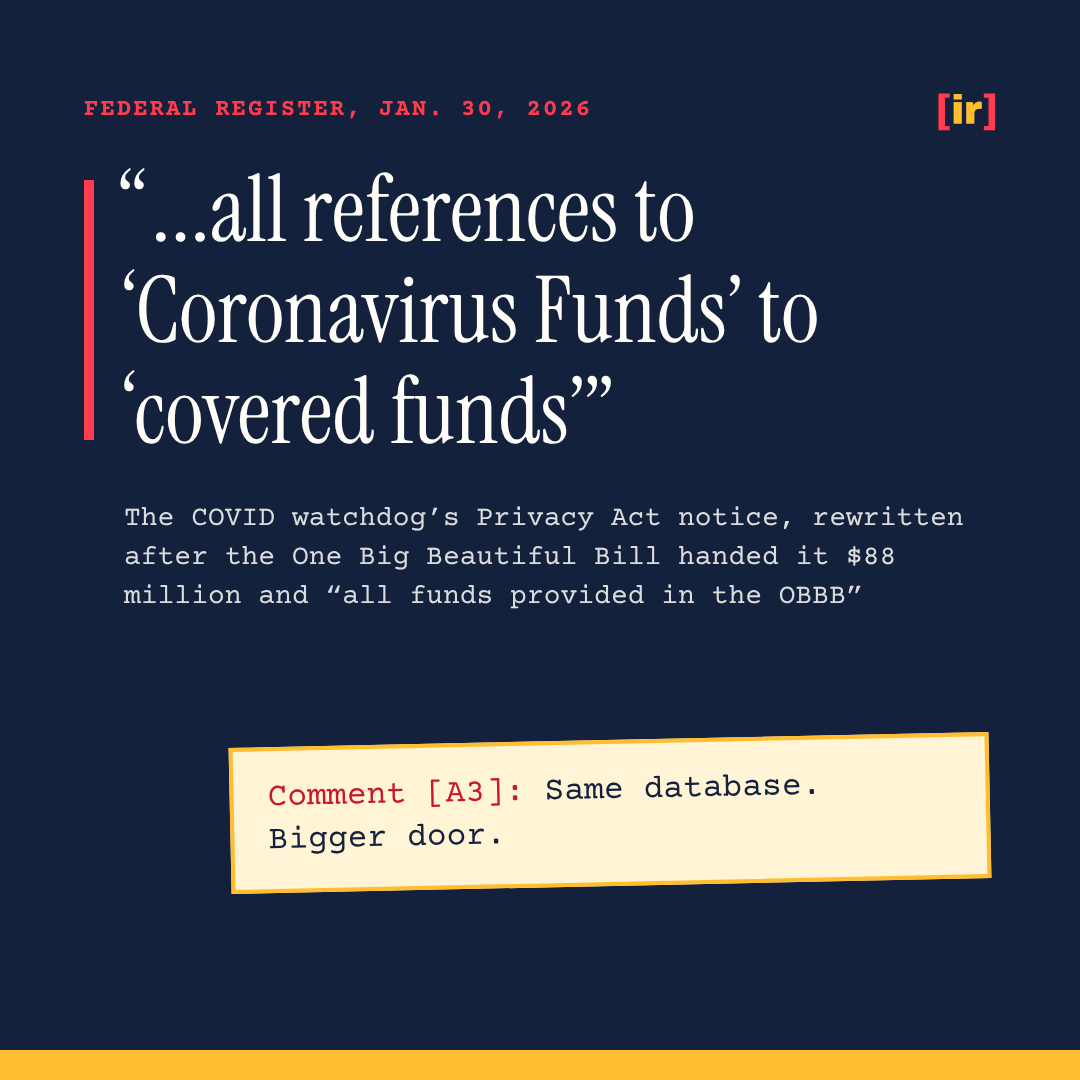
Who signed it? CIGIE's executive director, on Jan. 27, 2026. [D] Nobody took that job to fight this.
Now follow the pipe. In August, PRAC joined DOJ's new National Fraud Detection Center, alongside HSI, the FBI, IRS criminal investigators, about a dozen inspectors general and the secretaries of state of seven states (DOJ; FBI). [D] Seven secretaries of state. In a fraud center. With immigration agents. What exactly are they contributing? Nobody's said. [D]
And the cherry on top: under the Inspector General Act, a data match "performed by an Inspector General or by an agency in coordination with an Inspector General" isn't a "matching program" at all (5 U.S.C. 406(j)). [D] CIGIE's own guidance says agencies "can therefore engage in matching without following the [matching law's] requirements if the matches are conducted in coordination with an OIG" (CIGIE.pdf)). [D] No matching agreement, no data integrity board, no public notice. Just put an IG in the room. Good thing they've been picking the IGs. [P]
Brookings put it better than I can: the Privacy Act may not stop "a single centralized government database integrating agency records if the government chooses to follow the act's established procedures" (Brookings). [R] Would every piece of this survive a lawsuit? Maybe not. But a lawful-looking pipe is all you need on the day someone declares an incident and says the data has to be pulled together to check it. [P]
So: China memo, incident declared, FBI takes the evidence, and now there's a "need" to run every federally held record through the fraud pipe to find the "tainted" ones. That's your master database, with a Federal Register citation. [P]
Page 48 (hi again, Russ)
Guess which Project 2025 chapter wants OMB to "root out waste, fraud, and abuse in federal programs—for example, through the Do Not Pay program"? Russ's. Page 48 (Mandate). [D] The new routine use cites a 2025 Trump order and an OMB memo on Do Not Pay as its basis (M-25-32). [D] Book, order, memo, notice. Copy/paste, part two.
And here's the part that makes me want to scream into a pillow: while OMB was blessing the pipe, it was starving the people who run it. Congress gave PRAC $88 million. At the start of FY2026, OMB didn't apportion PRAC or CIGIE their money at all. Republican Sens. Collins and Grassley wrote Russ about the "policy decision" and asked, flat out, "who made this decision?" (letter). [D] OMB coughed up $5 million for PRAC for one quarter (Senate Judiciary). [D] A watchdog lawsuit (PEER, the Government Accountability Project and POGO) says CIGIE was left with about $24 million unapportioned (complaint). [D] OMB's explanation: inspectors general "have become corrupt, partisan" (MeriTalk). [R]
So OMB froze the council its own deputy chairs, kept the data engine running, pointed it at DOJ's fraud center, and now that deputy wants to run GAO, the office that's supposed to call out withheld money. [P] (GAO can sue over impoundment. Can it pick up the phone and call DOJ? Sure. Will it, with Russ's deputy in the chair? Place your bets.) [P]
Why would Russ want one pipe for every federal dollar? Here's my theory, and it's a theory: if you can flag a state's federally funded program as "improper payments," you have a fraud-shaped reason to hold its money. That's leverage over every state in the union, no vote required. [P]
Who's watching the watchers? (Spoiler: whistleblowers)
DHS shut down its outside privacy advisory committee in March 2025 (Federal Register). [D] The White House removed the Democrats from the federal privacy oversight board that January (Nextgov). [R]
SSA's inspector general, the office Congress asked to investigate what DOGE did with Social Security data, is now a partner in DOJ's fraud center. [D]
What we know about DOGE and your data came from insiders and court filings, not notices: SSA's chief data officer said a copy of the Social Security number file was put in a cloud environment [R], and SSA admitted in court that DOGE staff used Cloudflare, which is "not approved for storing SSA data," and that one signed a "voter data agreement" with a group trying to overturn election results (The Register). [R]
The IRS has agents at the FBI's domestic-terrorism task force using "facial recognition and tattoo analysis databases" (NYT). [R] Someone please warn the Secretary of War.
The checks are gone, so the check is people. If you work on any of these systems and something feels off, talk to a lawyer and a reporter, in that order.
The quieter version (the one that worries me more)
Maybe Dec. 18 comes and goes. Maybe nothing gets declared. The pipe is still there. The NSPM-7 center the FBI runs has produced "over 200 total arrests" (FBI testimony). [D] Federal prosecutors in California subpoenaed voter records from counties, the secretary of state and the DMV, charged people, and then cited those charges to vouch for the very list that picked them (Sacramento Bee). [R]
You don't need a coup on Jan. 3 if you can spend two years deciding who's on the rolls in 2028. [P]
What to listen for this morning
Ueland: Who made the call to freeze CIGIE and PRAC? Would he ever sue over withheld money?
Dennis Kirk: What exactly did he do inside the intelligence community IG's office?
LoSapio: Will he recuse from anything Palantir? Will CISA require the audit logs and tracing Palantir itself told NIST should be mandatory for AI systems?
Everyone: What do seven secretaries of state put into a DOJ fraud center?
My tin-foil hat is staying on through Dec. 18. If I'm wrong, great, I'll eat it. If I'm right, you heard it here first.
Hi again, Russ.
— Amanda
Fine print: [D] is a document, [R] is reporting, [P] is presumed, meaning my inference from the pattern. Government quotes are exact. This is a worst-case hypothetical, not a prediction, and nothing here accuses a named person of a crime.