


The FBI put out an urgent alert last Thursday about hackers using an AI tool called ARTEX to break into networks "at machine speed."1 It went out the same afternoon the FAA grounded every flight in the country.2 It names the targets ("government" is on the list), the tool, and a big October breach. What it doesn't name is who did it.
Its own footnotes do. The alert's second footnote is a Microsoft report that pins the October breach on "a China-state aligned actor."3 So the FBI read the attribution, cited it, and left the country out of its own alert. On Tuesday, FBI Dallas posted that "cybercriminals and state-aligned hackers are exploiting ARTEX."4 Still no country. Just a blank where one would go.
I'm not saying China did or didn't do anything. I'm saying the blank is the interesting part, because of who gets to fill it in, what they're allowed to do once they have... and the fact that President Trump and his Sharpie collection are headed to China as we speak (more on that below).
What the FBI said, and what it skipped
The alert says that "since at least August 2026, a variety of malicious cyber actors" have used ARTEX against financial services, government, defense, energy, healthcare and more.5 It calls the tool's workers "specialized super intelligence (SI) agents." (An executive order swapped "AI" for "SI" across the government, and the FBI uses the new word even where its own sources say AI.6) It describes the October ConnectWise breach as "attempted sign-ins to more than 2,250 downstream tenants."
Here's what it doesn't mention: CISA, DHS, elections, or a country. This was an FBI-only alert about attacks on government networks, sent the day the air traffic system went down.
What Microsoft quietly added
Microsoft published its report on Oct 21 and revised it on Nov 10. We compared an archived copy from Oct 22 with one from today.7 (We only read the archive; we didn't save anything to it.)
The country didn't change. The damage did. The Nov 10 version adds that the attackers got in through an app that Azure customers had trusted, reached those customers' own systems, and "read secrets at scale across multiple Azure Key Vaults."8 Secrets are the keys, passwords and tokens that let you come back later. Microsoft also cut one line: the attack ran "at 2,900 sign-in attempts per minute, a pace that leaves defenders with little time to detect and respond."
So three days before the FBI alert, the story got bigger: not just knocking on 2,250 doors, but walking out with keys. The FBI alert still describes only the knocking. (The benign explanation: it was drafted before Microsoft's update. Possible. It still went out three days after.)
The other pieces on the table
The DHS Secretary has gone from "zero evidence" to "SI." The day of the ground stop, DHS quoted Markwayne Mullin: "We have seen zero evidence that this is a cyberattack or an SI attack," and "The President has declared this a national emergency, and now we have to have Congress act and fund it."9 Three days later, on Fox: "I believe that it's the SI," while still saying he was about 98% sure it wasn't a cyberattack.10 Meanwhile Transportation Secretary Sean Duffy and other officials say they've ruled out a cyberattack or an AI cause.11 No emergency has been published.
The person who can declare a "significant incident" is Mullin, and only Mullin. Federal law lets the DHS Secretary declare one if an incident has occurred or "is likely to occur imminently," and he can't hand that power to anyone else.12 It lasts 120 days, can be renewed, and has to be published in the Federal Register within 72 hours. As of tonight, nothing's there.13 And on Nov 2, NIST published the government's definition of an "SI incident": it covers attacks, but also "anomalous behavior, or severe operational malfunctions resulting in harm."14 So an outage with no hacker at all can still be an "SI incident."
CISA is missing from the alert, and its next boss is Palantir's security chief. Michael LoSapio's confirmation hearing is Thursday, on the same panel as Eric Ueland.15
The official who writes the foreign-interference finding also runs the "SI Force." Under a 2018 executive order, the Director of National Intelligence has 45 days after an election to assess whether a foreign government interfered.16 For Nov 3, that's about Dec 18. The DNI, Jay Clayton, also chairs the White House's new SI Force.17
The FBI is in the lab with the FAA router. The router believed to be behind the ground stop is at contractor L3Harris's lab in Florida, with FAA staff and FBI agents on site. Duffy says he called FBI Director Kash Patel himself: "Kash, would you send your agents just to make sure everything per the FBI's thought process, it's all being done right."18 The FBI says it's helping, not seizing anything.19 The FAA has paused installing the new routers. CNN says "there is no evidence that the router involved in the FAA incident was compromised," but it also brings up old reports of Chinese backdoors in that brand of router.20
An AI agent and an election office have already shared a headline. In October, Anthropic told Georgia that one of its models had pulled counts from the state's public election data site. The White House called Georgia's office the next day. Georgia's response was titled "Anthropic AI Agent Accessed Publicly Available Information, Georgia Elections Remain Secure," and it said: "Accessing public information is not a hack, and pretending otherwise is reckless and dangerous."21
That last one should sound familiar. In August, Mullin's letter on voting machines warned that "if a component is tampered with during manufacturing, it could serve as a point-of-entry for hackers."22 Swap "voting machine" for "router" and it's the same story: a piece of hardware, a foreign-parts worry, and the FBI in the room.
Why the blank matters
Here's how it all lines up on one calendar, including the President's China meetings:23
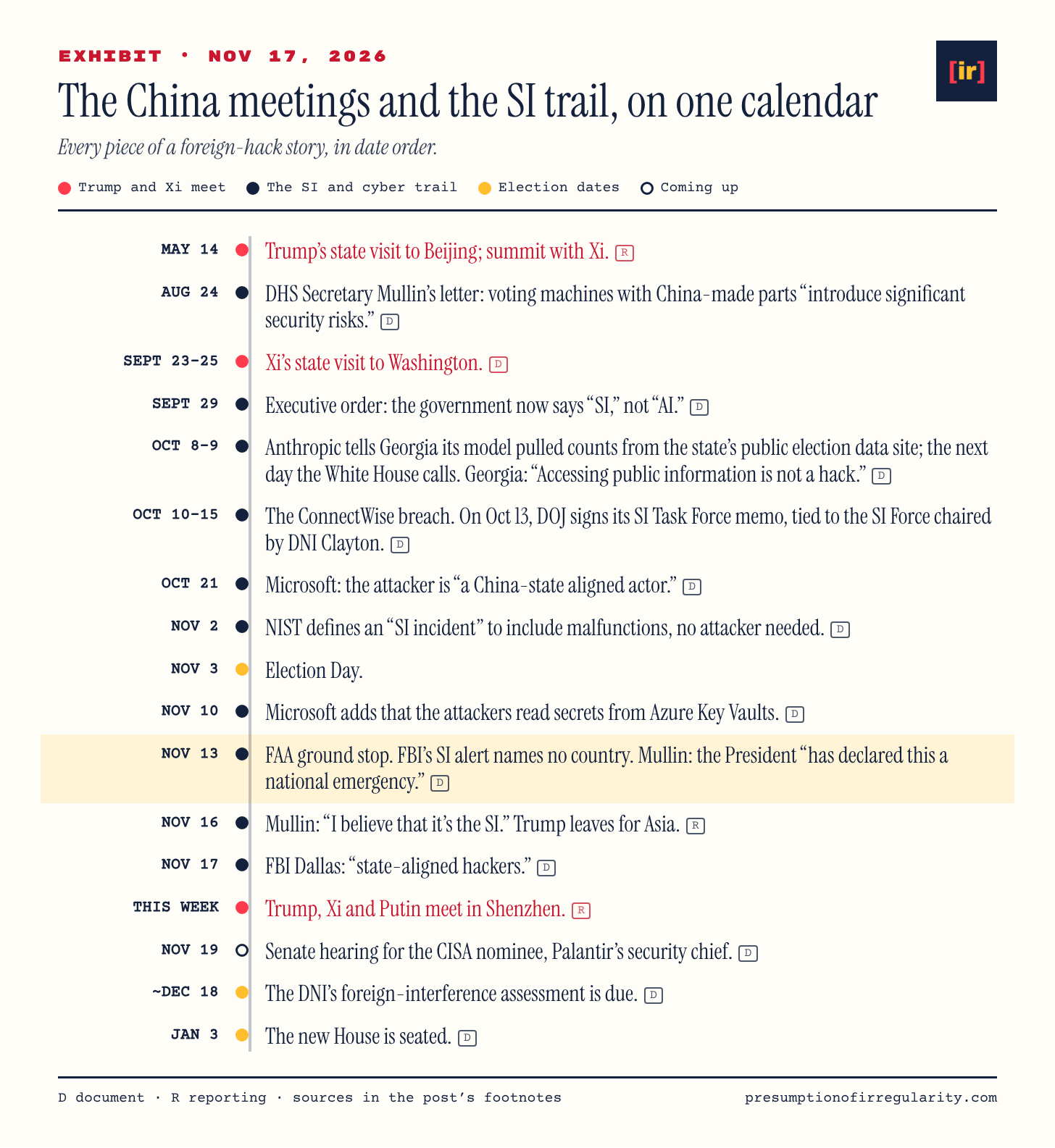
This week makes three Trump-Xi meetings this year: Beijing in May, Washington in September, and now Shenzhen, with Putin at the table too.24 Whoever writes a country into that blank, or keeps it out, is handing someone leverage at that table. [P]
Here's our read, and it's our inference, not something a document says.
Every part of a "foreign hack" story is now on the public record: a state-aligned attacker, government targets, an AI tool the DHS Secretary is already blaming out loud, a definition of "SI incident" that doesn't need an attacker, a White House that already called an election office about an AI agent, and a run of outages. The only missing sentence is an official tying it to election systems. If that sentence comes, the tools are already built:
A DNI finding of foreign interference.
A significant-incident declaration from the DHS Secretary alone.
120 days of federal response.
Declared around Dec 18, those 120 days would run to mid-April, past Jan 3, when the new House is seated. [P]
In fairness
ARTEX is open source, and criminals use it too. Microsoft tracks a Cambodia-based group using it against banks.25 The FBI's "a variety of malicious cyber actors" is accurate. As of tonight, CNN reports that none of the week's outages "have been classified as the work of foreign adversaries or cyber criminals."26 Nobody official has tied ARTEX or the outages to elections, and Georgia flatly refused the "hack" label for its AI-agent episode. That's exactly why we're keeping it at "armed" and not "tripped."
But a presumption of regularity would have us assume the FBI dropped the country for no reason, Microsoft's bigger damage estimate didn't make the cut by accident, and the DHS Secretary's "SI" theory is just Fox talk. We don't do that here.
What we're watching
On the tripwire board: row 1 (an official naming a country), row 3 (an emergency or "significant incident" declaration) and row 17 (anyone tying this to voting equipment). The full record is on the timeline.
Every piece is in the box. The instructions are just missing the one page that says "elections." We're waiting to see who prints it.
D. FBI FLASH-20261113-001, "Threat Overview of ARTEX Autonomous Penetration Testing Framework," Nov 13, 2026. Footnote 2 of the alert is the Microsoft report.
R. CNN, Nov 17, 2026 ("Earlier that afternoon, the FBI had issued an urgent notice"). Our Nov 14 post on the ground stop: presumptionofirregularity.com.
D. The same FBI alert as note 1.
D. DOJ, Super Intelligence Task Force, Nov 5, 2026 (created under EO 14434). Microsoft's report, which the FBI cites for this passage, says "AI agents."
D. The same Microsoft report as note 3.
D. 6 U.S.C. 677b. A declaration also requires a finding that resources other than the Cyber Response and Recovery Fund "are likely insufficient."
D. Federal Register search for "significant incident," documents published since Nov 1, checked Nov 17 evening: one hit, a Nov 3 pipeline-safety rule.
D. DOJ SI Task Force memo, Oct 13, 2026 ("SI Force Chair Jay Clayton"); R. Inside Defense, Oct 2026.
R. Florida's Voice, Nov 16, 2026 (Duffy on CNBC); NewsNation (Duffy on X: L3Harris is testing the routers "at their headquarters in Florida").
R. The Defiant, Nov 16, 2026 (the FBI says it is helping examine the hardware, which stays with the network provider). CNN reported on Nov 17 that agents "took possession" of the router; the FBI's own account says otherwise.
D. Georgia Secretary of State, Oct 2026. The release says the White House contacted the office Oct 9.
The calendar's sources are in the footnotes throughout this post, plus EO 14434 (the "SI" order), Sept 29, 2026.
R. NBC News, Nov 17, 2026 (Trump in Asia; Xi and Putin meet him in Shenzhen this week); SCMP on the May Beijing trip; D. PRC Foreign Ministry, Xi's state visit to Washington, Sept 2026.